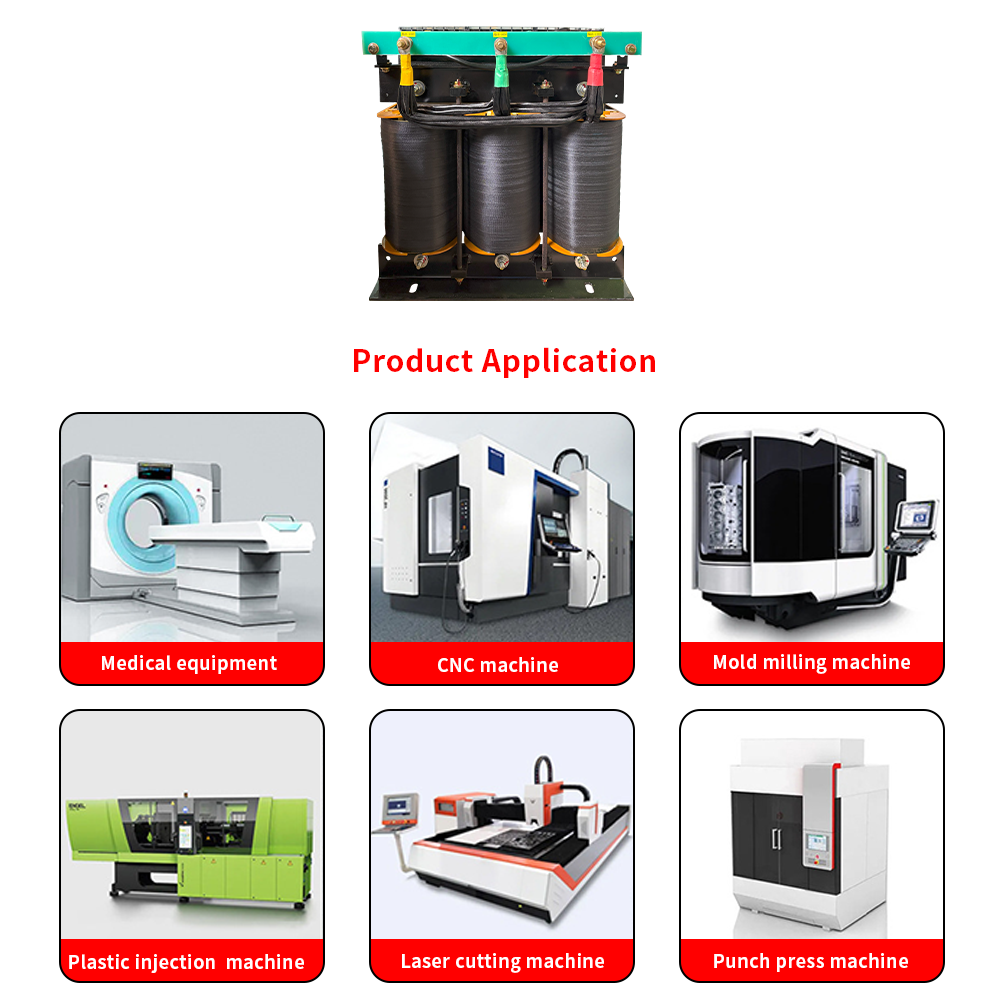
On the precision instrument operating table in the medical operating room, in the server power supply system in the data center, and in the precision measurement devices in the laboratory, isolation transformers act as invisible security guards, constructing protective barriers for power transmission. This special power equipment achieves electrical isolation and safety protection function through a unique electromagnetic coupling mechanism, while ensuring energy transfer efficiency. Its operating mechanism not only follows the basic laws of electromagnetic induction, but also demonstrates unique engineering wisdom in structural design.
1、 The physical barrier of electromagnetic coupling
The core structure of the isolation transformer is made of high permeability silicon steel sheets stacked together to form a closed-loop magnetic circuit system. The primary winding and secondary winding are placed on different iron core columns, and this physically isolated winding layout provides the necessary spatial conditions for electromagnetic energy transfer. The thickness of the dielectric barrier constructed by the insulation material between the windings is precisely calculated to effectively control the distributed capacitance between the windings while meeting the withstand voltage requirements, with a typical value controlled within the range of 5-20pF.
The design of the insulation system between windings adopts a multi-layer composite structure, consisting of a sandwich insulation system made of Nomex aromatic polyamide paper, polyester film, and epoxy resin, which can withstand a power frequency withstand voltage test of 3kV/min. This structure reduces the coupling capacitance between windings to less than one-third of that of conventional transformers, effectively suppressing the conduction of high-frequency interference signals.
The magnetic shielding layer is made of Permalloy material and wrapped around the winding in a 0.1mm thick strip structure, limiting the leakage flux to within 0.5% of the core magnetic circuit. This design maintains the magnetic induction intensity of the transformer at around 1.6T at 50Hz power frequency, ensuring energy transmission efficiency and reducing electromagnetic radiation interference on sensitive equipment.
2、 Safe channel for energy transfer
When an alternating current passes through a winding, an alternating magnetic field forms a change in magnetic flux of Φ=BScos ω t in the iron core. The secondary winding generates induced electromotive force according to Faraday's law of electromagnetic induction, and its instantaneous value follows the differential relationship of e=- Nd Φ/dt. This non-contact energy transfer method physically cuts off the direct electrical connection between the primary and secondary circuits.
The voltage conversion between windings strictly follows the turns ratio law of U1/U2=N1/N2, and the phase difference is controlled within ± 2 °. Under rated load conditions, the voltage regulation rate is kept below 3% to ensure the stability of the output voltage. This precise voltage transformation characteristic makes isolation transformers play an irreplaceable role in precision instrument power supply systems.
The load impedance is equivalent converted through magnetic field coupling, and the secondary side load impedance Z2 is reflected in the primary side equivalent impedance Z1 '=(N1/N2) ^ 2Z2. This impedance transformation characteristic enables isolation transformers to achieve impedance matching between circuits, playing an important role in audio equipment and measuring instruments.
3、 Engineering implementation of safety protection
The insulation system between windings can withstand a 4kV power frequency withstand voltage test, with leakage current controlled below 0.5mA. The dual insulation structure design enables the equipment to have an IP67 protection level, and can maintain an insulation resistance of over 500M Ω even in humid environments. This insulation performance provides reliable direct contact protection for operators.
Common mode interference suppression is achieved through symmetrical winding and electrostatic shielding layer, resulting in a common mode noise attenuation of over 60dB. In medical IT systems, isolation transformers combined with insulation monitoring devices can limit equipment leakage current to below 10 μ A, meeting the IEC60601-1 medical electrical equipment safety standard.
The isolation design of the grounding system breaks the traditional TN system's grounding circuit and forms an independent IT power supply system. This configuration increases the system's impedance to ground to over 50k Ω. In the event of a single-phase grounding fault, the fault current is limited to below 5mA, effectively preventing arc discharge and electric shock accidents.
In modern power systems, isolation transformers have surpassed the simple voltage conversion function of traditional transformers and evolved into comprehensive protective devices that integrate safety protection, electromagnetic compatibility, and power quality improvement. From life support systems in operating rooms to industrial automation production lines, from uninterruptible power supplies in data centers to power supply systems in spacecraft, these safety devices based on electromagnetic coupling principles continue to safeguard the power lifeline of modern civilization. With the development of new material technology and intelligent monitoring technology, isolation transformers are evolving towards higher safety levels and lower energy consumption losses, providing technical support for building a safer electrical environment for humans.